
Wings of imagination
A moment of imagining that one orchid can whisper to another, reminded us of childhood times when our imaginations kept us keen company. As adults, has living got in the way of imagining?
Chantal walked into the bathroom. It was Wednesday morning and she had a lot on her mind. Her daughter, son-in-law and granddaughter had flown out early that morning to go on a two month working holiday abroad. No more “granny day” for two whole months.
On the window sill five orchids in various stages of flowering, were silhouetted against the morning sun. One miniature orchid’s stem was full of buds with two flowers starting to stretch and show off their lemon yellow petals tinged with crimson. It was curved over another miniature plant that was struggling. It only had small slightly limp looking leaves and no stem to be seen. There was some hope as a new leaf had started to poke out from the middle.
In that moment Chantal imagined that the flowering orchid was whispering encouragement to the smaller, more fragile one:
“You can do it. Just hold on. You will also be growing tall with flowers soon.”
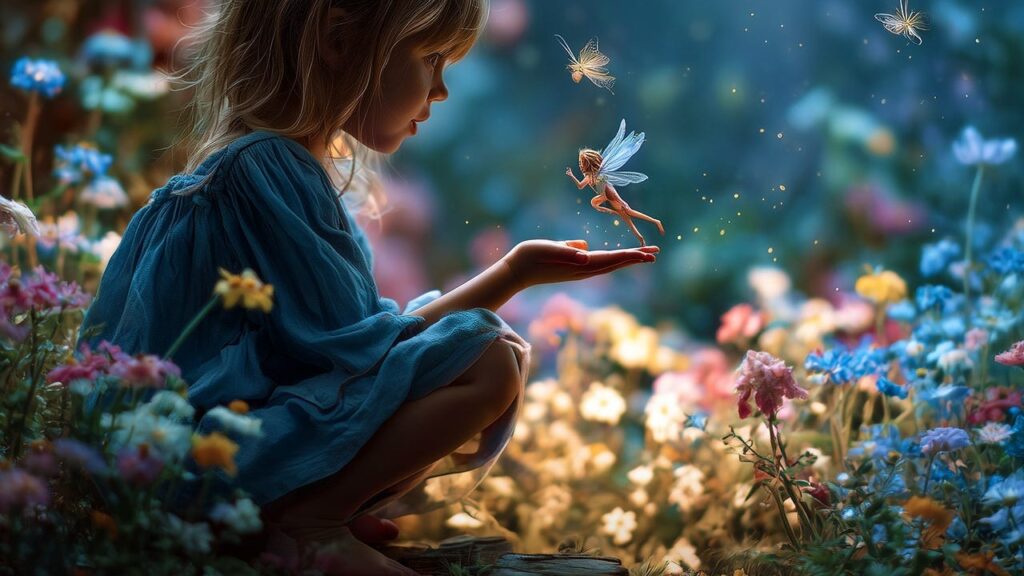
Chantal smiled to herself as she returned to the office, thinking that, as a child, she would have imagined fairies and imps living in and around the plants. Eight year old Chantal may have made a small home for them with the pebbles that balanced in a small stack next to the largest orchid, using the dried orchid flowers to make beds and other tiny furnishings.
Imagined fairies and friends
Imagination played a big part in the games Chantal played as a child. Many hours were spent in a make believe world acting out the stories she read.
She loved fairytales most of all and imagined fairies, imps and pixies gathered under the leaves of the elephant ear plants and living quietly in the lilies and cannas. They wore hats of purple jacaranda flowers and skirts made of peach tree blossoms. Their gossamer wings glinted with rainbow hues and sparkled in the sun as if outlined with tiny crystals.
Do eight year olds even read fairytales these days? she mused, returning to her seat and the computer screen.
Matthew was an early and avid reader. Books helped him navigate an otherwise overwhelming and scary world. He loved the Famous Five and getting lost in the world of child detectives. When he wasn’t reading he played with his imaginary friends building magnificent structures out of Lego.
It was the age of Westerns, films about courageous and crazy “cowboys” fighting greedy bank robbers and wild “Indians”. They would be considered very politically incorrect today but the swashbuckling stories captivated his five year old mind. Matthew played make believe cowboys and indians with or without friends. He even had a small teepee that added to the imaginary landscape.

Imagination is boundless
In a serendipitous choice we watched the film “White Bird” on Thursday evening. A delightful story, starring Hellen Mirren, as Sara Blum, the French grandmother to a troubled teen, Julian. She tells him her story of living through the Nazi invasion of her small town during World War 2.
She loves to draw, and has a gift that she does not show off to many. Her teacher, Mlle Petitjean, played by Patsy Ferran, confiscates her sketch book during class. After the lesson, she hands it back to the young Sara Blum, played by Ariella Glaser. She tells her that she has a gift and encourages her to continue to draw
“The world of reality has its limits,” she says as Sara takes the book back, “The world of imagination is boundless.”
As a Jew, Sara narrowly escaped being captured by the German soldiers who came to remove all the Jewish children from her school. Juliene, a fellow classmate who was ridiculed for being crippled by polio, helped her get away. He and his family with boundless kindness and enormous courage hid her in their barn where she stayed for the rest of the war.
Sara’s imagination helped her endure the boredom and persistent fear of being discovered, and brought some colour to Juliene’s life too. She survives the war and goes on to be a renowned artist.
The other Matthew visits
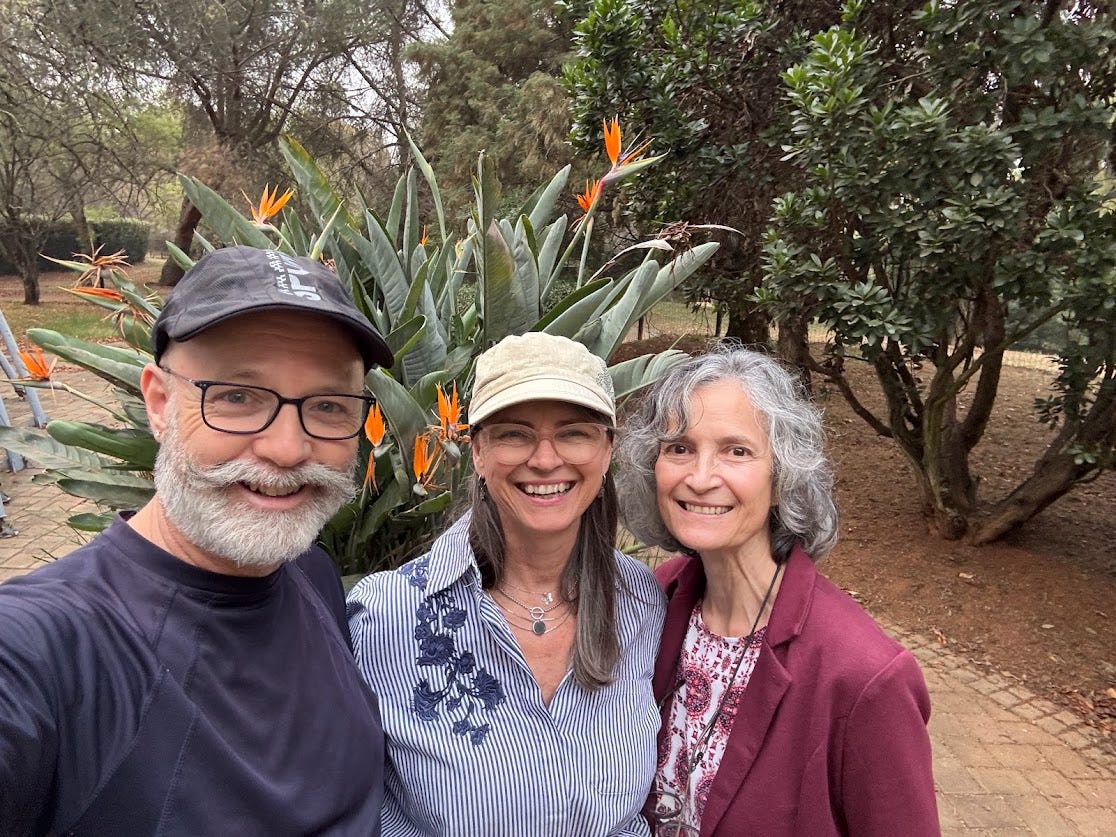
Matthew Bushell, our partner in the UK, visited us on his way to a conference in Tokyo. Yes, it is an obvious stop over (not). He arrived with impeccable timing on Saturday morning. We were watching the Springbok vs All Blacks rugby game.
“You’ve arrived just in time,” yelled Chantal, opening the door to a gust of wind. “It’s half time.”
“Oh good,” said Matthew B, plonking his bright yellow suitcase in the middle of the sunroom.
“The Springboks had a dreadful first half,” grumbled Matthew G, “But come sit down, can I get you something to drink?”
Matthew B’s infectious energy and the craft beer he had managed to bring, unscathed from Northampton, definitely made a difference in the second half. He cheered the guys in green like they were his own team. The Boks still lost, but they played with intent and drive that we had not seen before in the game.
It is the first time he is in South Africa and Matthew B has slotted in as if he was part of the family. On our Sunday walk the conversation cycled round to imagination again.
“How did imagination show up in your childhood?” Chantal asked.
“I was a lonely child,” answered Matthew B, “I yearned to belong. I often found myself on my own even though there were other kids on the street. I would sit on the dilapidated wooden structure at the so-called play area at the bottom of the road and imagine being surrounded by the other children who were looking at me as someone they wanted to be with.”
Wonder, create, imagine
Chantal’s imagination offered her an alternative world filled with magic, beauty and wonder. Matthew G used his imagination to become a brave, powerful person fighting for justice or sovereignty. Matthew B filled his solitary moments imagining what it would be like to be accepted, and sought out as part of a community.
Our imagination is so powerful. We all know the saying, often attributed to Walt Disney, “If you can dream it you can do it.” Psychologist Albert Bandura and best selling authors, Dr Joe Dispenza, and Bruce Lipton are some of the many psychologists, coaches, writers, researchers and inspirational speakers that advocate and encourage the benefits of visualising or imagining a different, more prosperous, successful future.
Vietnamese Zen Buddhist monk Thich Nhat Hanh taught that visualization and mental imagery are vital practices to deepen mindfulness, cultivate interconnectedness, and dissolve the illusion of separateness. From West Africa, Dagara elder and shaman Malidoma Patrice Somé emphasized the power of ritualized imagination and visionary trance to access ancestral wisdom and communal healing.
We can change our lives, intensify mindfulness practice and heal using our imagination. We can also use it to make a moment more enjoyable, lighter and relaxed.
Do we use it enough? Especially as we grow older, does living get in the way of imagining? Sometimes it feels as if the strains of being an adult dull our playfulness and impede our willingness to unshackle from the constraints of reality and all its concerns.
What will it take to just let go and allow our imagination to run free?
For a moment, cast your mind back to your imaginative play as a young child. Watch as you create worlds, live lives and surround yourself with supportive friends. Notice how it feels. Hold onto that feeling as you pull yourself back to your adult self and wonder and create and imagine some more.
Until next time.
Yours in feeling,
Chantal & Matthew
Credits for this issue — Images: 5th Place
Written by

Chantal Dawtrey
Supporting women, especially in midlife and beyond, to navigate life transitions · Emotional fitness coach
Chantal supports women, especially in midlife and beyond, to navigate life transitions. She designs and delivers data informed digital programmes that build organisational emotional fitness. She helps people move beyond habitual patterns into greater awareness, agency, and well being.
With over 15 years of coaching experience and more than two decades in facilitation and human development, Chantal partners with individuals, teams, and organizations to build emotional resilience, enhance self-awareness, and develop sustainable well-being strategies.
Her primary focus as a coach is supporting women, especially those in their 50’s and beyond, to navigate profound life transitions with clarity, steadiness and self-reconnection. Finding answers to questions about identity, purpose, belonging and desire to an emergence, a reclamation and a return to self.
If you're going through a transition and would like support, let's talk.

Matthew Green
Reducing the Certainty Deficit in high-performing people and teams · Emotional fitness coach
Matthew works with athletes, performance teams, and anyone who wants to reduce the Certainty Deficit in their situation or context.
The Certainty Deficit is the space between what you can do and what your body will let you do when it counts. It is context-specific and situational. A person or athlete can have zero deficit in one situation and a significant one in another.
The body holds beliefs that keep the Certainty Deficit in place. These beliefs run deeper than self-talk and faster than any conscious strategy. When they shift, the ceiling shifts, and new possibilities arise.
Matthew is also an emotional fitness coach who supports individuals to live and lead from a place of inner clarity and stability. The work is somatic-first, practical, and grounded.
If you're seeing a pattern that current approaches haven't shifted, let's talk.
My origin story: Why elite athletes underperform when it counts
More from Enabling the How

It’s the oats
After weeks of challenge on many fronts it felt as if a threshold had been crossed. A smoother week with resolutions and relief.

The soundtrack to our lives
Leah knows what music she likes, so do we. Music is important to us and has a useful lesson to teach too.

All is not fair
The Boks are back and it’s great to be on the winning side but a wrong call by the ref can change that and the way we feel. All is not fair so managing our state is the real job to be done.