
Trust Yourself
An Oscar winner, a focus on motherhood and what advice we turned to when we doubted ourselves. With an overabundance of information are we forgetting to trust ourselves?

“And the Oscar goes to:…”
It wasn’t Hamnet. Not for Best Picture or Best Director, or Best Actor. It did, however, win for Best Actress. Jessie Buckley won for her performance as Agnes Shakespeare. She dedicated her award to the “beautiful chaos of a mother’s heart.”
On Sunday in a crowded dining room sat four women: a great grandmother, a grandmother, a mother and an aunt/great aunt. There, with their men, to celebrate the second birthday of the two year old girl child and the newest soul: a four week old baby boy.
Arms in varying stages of softness reached to hug the little girl and then to cradle the infant. As the men joked and jostled, the women sat and spoke about the joy of new life. They shared memories of births and the struggles of finding a rhythm with each new baby. Each new life so different to the last or the first or just different.
Each one of those women knows too well the beautiful chaos of a mother’s heart.
Books and advice
To have children is the most demanding, trying, tiring, challenging and rewarding of experiences. We rarely get the children we expect. Chantal always said that her children were her teachers. There were few guides then, although she remembers having one book that she followed religiously. Today she cannot remember what it was called.
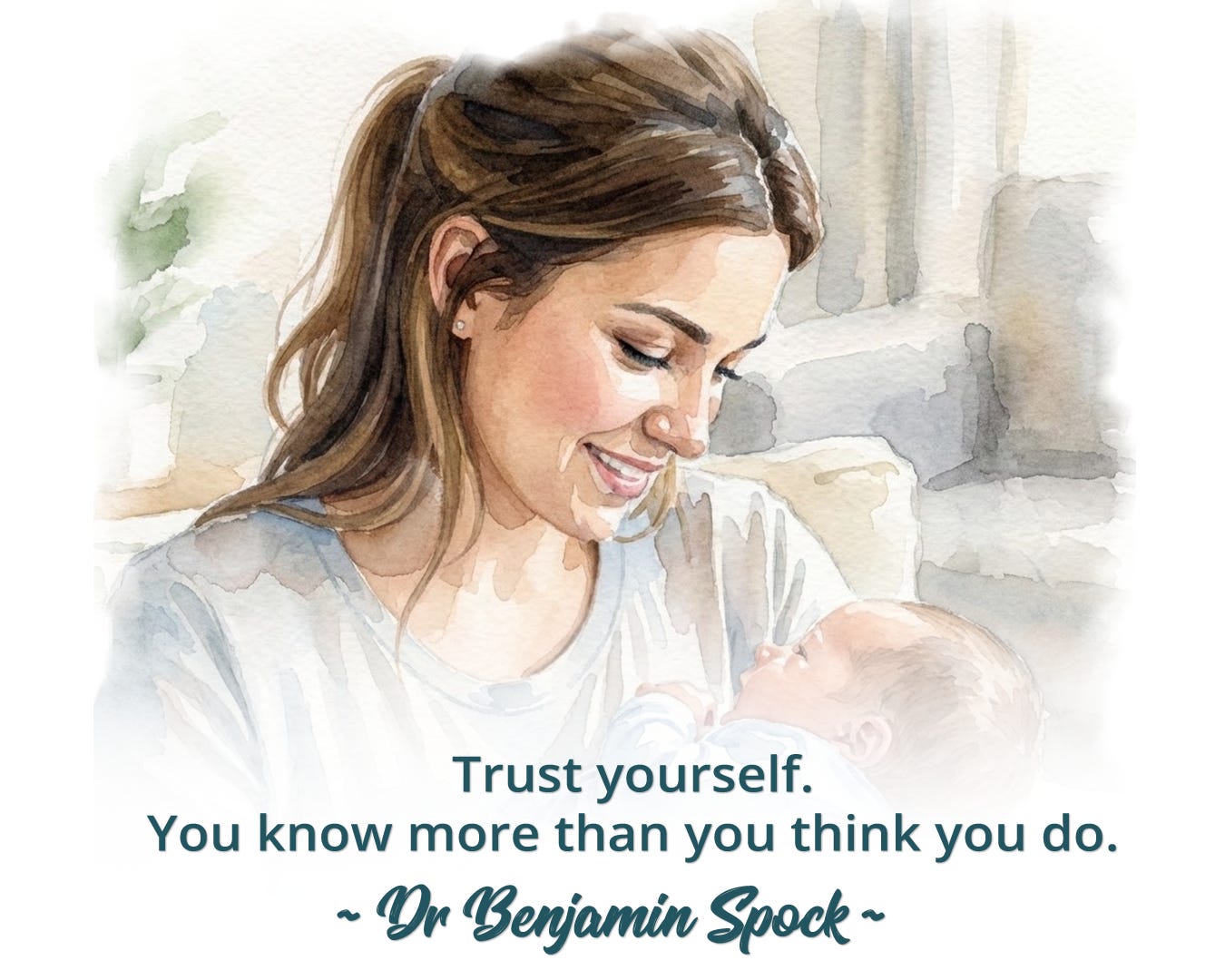
In our parent’s day it was the word according to Dr Spock. In 1946, Benjamin Spock, an American paediatrician wrote: The Common Sense Book of Baby and Child Care. By his death in 1998 it had sold fifty million copies and had been translated into 39 languages.
It was the bible of baby and child care. Mothers everywhere appreciated the advice and reassuring tone of Dr Spock who urged all parents to trust their instincts and abilities. The famous first line of the book reads, “Trust yourself. You know more than you think you do.”
These days there are libraries of books, hundreds of social media channels and an expert on every corner, virtual or otherwise, to turn to for advice on child rearing. As much as it’s wonderful, it can also be overwhelming and confusing. Too much information and conflicting information at that, do not make for a happy, confident, new mother.
So much information
With so much information at our finger tips do we allow ourselves to trust that we may already know? AI makes it even easier to source data and produce content that looks genuine. It’s becoming more and more difficult to know what is real and true.
Such easy access is a double edged sword. It is a huge time saver to have AI like Gemini source and summarise key journal articles on a subject we are researching. Instead of taking hours to find relevant podcasts and YouTube channels on a particular subject, AI does the work and hands it to us on a plate. Used incorrectly, though, AI can make us lazy.
For example, if AI is used to write the whole article from scratch with no human oversight. That’s cheating. It also could be incorrect information – there goes your reputation.
If you work with it enough, you soon get a sense of whether a machine or a real person wrote an article. The piece lacks depth and a signature “voice”. It may be too perfect, us humans make grammatical errors all the time, we split infinitives and write redundantly.
Overuse of AI risks us all sounding the same. How sad is that? Our unique perspectives and creativity watered down by, what? An overstimulated sense of urgency? Too much to do with too little time and little sense? A lack of trust in our own ability to deliver a decent piece of work?

Trust yourself
Letting machines do work that we should do risks making our creative muscles floppy. It risks shrinking our special qualities and reduces our ability to think for ourselves. It makes us trust our abilities less.
What does it take to trust ourselves? Trust means having confidence and faith in ourselves. It means believing in ourselves. It sits at the root of self awareness; growth and development. It says, I know I will make mistakes, but I trust that I will be able to learn from them, bounce back and do better next time.
Trust is fundamental to living. We trust that the sun will come up and that we will be tethered to the ground by gravity. We trust that we can take the next breath and the next one without needing to think about it.
What we don’t always trust is the signals that our bodies send us. Instead of sitting with discomfort and listening to what our systems are saying, we turn to “experts”, social media and our own research. We have become so deaf to our own body, intuitions and knowing that we have lost touch with what is simply better for us.
It is time, once more to trust ourselves, because we actually do know more than we think we do.
Until next time.
Yours in feeling,
Chantal & Matthew
The Pattern I Couldn’t Unsee
Ten years ago I watched the world’s leading try scorer drop the ball over the tryline with a World Cup record in his hands. His body had already decided where he sat. Alongside the record. Never above it.
Everyone saw what happened. I could see why.
I knew what was causing it. I just had no way to reach it. This is the story of how I went from seeing it to being able to change it.
Credits for this issue — Images: 5th Place
Written by

Chantal Dawtrey
Supporting women, especially in midlife and beyond, to navigate life transitions · Emotional fitness coach
Chantal supports women, especially in midlife and beyond, to navigate life transitions. She designs and delivers data informed digital programmes that build organisational emotional fitness. She helps people move beyond habitual patterns into greater awareness, agency, and well being.
With over 15 years of coaching experience and more than two decades in facilitation and human development, Chantal partners with individuals, teams, and organizations to build emotional resilience, enhance self-awareness, and develop sustainable well-being strategies.
Her primary focus as a coach is supporting women, especially those in their 50’s and beyond, to navigate profound life transitions with clarity, steadiness and self-reconnection. Finding answers to questions about identity, purpose, belonging and desire to an emergence, a reclamation and a return to self.
If you're going through a transition and would like support, let's talk.

Matthew Green
Reducing the Certainty Deficit in high-performing people and teams · Emotional fitness coach
Matthew works with athletes, performance teams, and anyone who wants to reduce the Certainty Deficit in their situation or context.
The Certainty Deficit is the space between what you can do and what your body will let you do when it counts. It is context-specific and situational. A person or athlete can have zero deficit in one situation and a significant one in another.
The body holds beliefs that keep the Certainty Deficit in place. These beliefs run deeper than self-talk and faster than any conscious strategy. When they shift, the ceiling shifts, and new possibilities arise.
Matthew is also an emotional fitness coach who supports individuals to live and lead from a place of inner clarity and stability. The work is somatic-first, practical, and grounded.
If you're seeing a pattern that current approaches haven't shifted, let's talk.
My origin story: Why elite athletes underperform when it counts
More from Enabling the How

It’s the oats
After weeks of challenge on many fronts it felt as if a threshold had been crossed. A smoother week with resolutions and relief.

The soundtrack to our lives
Leah knows what music she likes, so do we. Music is important to us and has a useful lesson to teach too.

All is not fair
The Boks are back and it’s great to be on the winning side but a wrong call by the ref can change that and the way we feel. All is not fair so managing our state is the real job to be done.