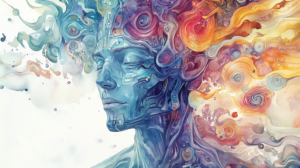
The feelings we associate with our experiences contribute to our sense of self and our identity. We can use Shape of Emotion to regulate the difficult feelings that hold us back and start to uncover the more generative, whole, perfect human being that we already are.
I am because I feel…
I remember being livid at my parents. I stood behind a large bush in the centre of our garden in an ordinary middle class suburb in Johannesburg. I glared at the wall that made up the front of the house. My parents sat in the parqueted floored lounge on the other side of this wall. I should have had x-ray vision for all the staring I was doing at it. My mouth drooped into a pout as I sulked. My eyebrows drew together in a deep scowl. My mother popped her head out of the front door and called for me. I scuttled further into the bush nursing my upset.
I cannot remember what I was angry about, nor why. I do know that I was about three years old. I don’t remember very much from those young years, but I can still feel that anger, the sulking. The righteous indignation at some hurt or offense. The reason I can still recall that event, as disconnected and incomplete as it is, is because of those feelings.
The influences of emotion on memory
We remember more easily when there is an emotion attached to the memory. We also suppress memories because the emotion attached is so traumatic we cannot deal with it. Because we feel, we remember, because we remember, we have a history, because we have a history we have an identity. I am because I feel.
Those feelings offer us a valuable opportunity to heal. While reflecting on this topic Matthew told this story:
“I was seventeen years old and going through a particularly difficult patch in my life emotionally. My mother, in the absence of any other known alternatives, sent me to see a psychologist. I mean, this was the go-to thing to do, there were no other options. I was handsome, sensitive and vulnerable. The psychologist made a move on me. I may have read him wrong but that’s how I interpreted it. I was shocked, furious, I felt violated. I never returned nor did I go to anyone else.
I never wanted to feel that way again. I never wanted to be put in that kind of position again. So I developed an incredible capacity to deal with my stuff on my own. I became extremely resilient and chose to “self-medicate” when it came to dealing with difficult emotions and feelings rather than going to someone outside or external.
I discovered Louise Hay and immersed myself in affirmations and how our thoughts affect our wellbeing, then deep dived into Neuro-linguistic programming (NLP). I encountered Emotional Freedom Techniques (EFT) and tapping when my mother discovered it after being diagnosed with cancer. All of this culminated in me developing Shape of Emotion.
If it wasn’t for that unpleasant interaction with the psychologist I would never be here today doing what I believe I am meant to do.”
Understanding of self and identity
The feelings we associate with our experiences contribute to our sense of self and our identity. There is a role for both difficult and positive feelings. We have to have the dark to see the light. The downs to appreciate the ups. It is when the difficult feelings hold us back and keep us stuck in unresourceful behaviour patterns that Shape of Emotion can be used to clear them. In the clearing of the muddy, murky layers of unwanted and unneeded feelings, we both honour and transcend the emotional hooks and complexes that have defined our lives. We start to uncover the more generative, whole, perfect human being that we already are. I am because I feel, always.
Image credit
Share the magic
If you like this week’s principle, save it, share it or download it using the image below.

“Individuality is founded in feeling” -William James

You may also enjoy reading these
-
The window Arsenal struggles to close
Arsenal lost 4 matches in 3 weeks, each decided in the same 20-minute window. The Certainty Deficit explains why.
-
Why the Quad God Choked at the Olympics and Won Worlds Five Weeks Later
Ilia Malinin, the “Quad God”, scored 329 at Worlds and 156 at the Olympics. Five weeks apart. Same body. Same jumps. The Certainty Deficit explains why the Quad God delivered in one and collapsed in the other.
-
The Kick His Body Won’t Let Him Take
Manie Libbok kicked 73% for the Stormers. 58% in a Springbok jersey. Coach Rassie Erasmus spent two years engineering around the problem. The Certainty Deficit remained after all of it.



More articles from 5th Place
-
The emperor’s new emotions
Anthropic, the makers of Claude AI, missed a trick or two in trying to give Claude healthier psychology.
-
When He Said It Out Loud
Colson Baker stopped a show at the O2 Arena and said it out loud. Standing there with my daughter Darcy, something I’d been carrying for a long time got answered.
-
Why you feel worse after therapy & why it’s not your fault
Feeling worse after trying therapy or medication isn’t a sign you’re broken. It’s often a signal that the traditional approach is missing a crucial piece. Discover why your frustration is valid and how a different way, rooted in your body’s own intelligence, offers a path forward.