
Chaos places
A book about a place of mayhem that offers opportunity amidst uncertainty leaves us wondering about this place we live in and how chaos is necessary for creation and life.
We drove around the corner on Rustenburg Road towards the Service Station Café and Love Books. Chantal glanced down at the car’s clock.
“It’s not even 17:30, how come we are so early this time?” she asked.
“I think it’s going to be popular given all the hype about it. It’s better to get here early”, said Matthew.
We are seldom early for anything but as we turned into the small car park there was barely an open space left. We squeezed into the second last one and felt sorry for the three cars trying to get in. It was now full. Chantal was grateful for Matthew’s instincts.
Inside it was already buzzing with people. The Service Station Café had been opened to allow for more seating. A large table of snacks and a counter offering wine or water was two deep. We found seats and collapsed. Very quickly we were squeezed in by others claiming places to sit. The place hummed with conversation. The volume got louder as bodies, unable to find seats, crammed against each other, waiting.
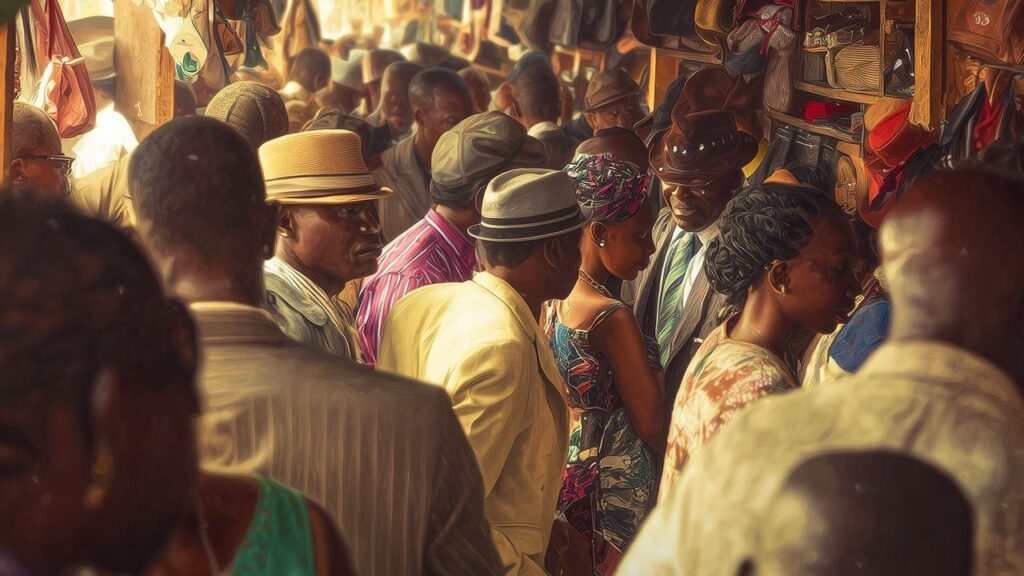
Mayhem market
Looking around, this was not our usual crowd. Mostly white, academic or arty. The women had a certain nonchalant style. Short asymmetrical hair cuts or long and clipped back, round-rimmed glasses in colourful frames, and clothes from Big Blue. With them their older, blander men were often tall, balding and stooped.
We were all there for the book launch of The Chaos Precinct by Tanya Zack. Tanya is an urban development planner who specialises in policy, informal and sustainable development and regeneration. She tells the story of an area in Johannesburg inner city that has been moulded into a trading post by migrant Ethiopians.
It is a chaotic market place carved out of old medical blocks and forgotten high rise buildings by Ethiopian dealers. Hundreds if not thousands of compact, sometimes as small as a metre square, shops sell clothes, underwear, shoes, belts, jewellery, bags and nail clippers to waves of shoppers that flow in from outside South Africa.
This unplanned, unzoned, hub of informal consumerism turns over double that of Sandton City Mall, which towers in the centre of the “richest square mile in Africa”. Of course there is danger and violence, crime and corruption. Mostly in the form of green gilled xenophobia and police that grab and destroy instead of serve and protect.
There is order
In the chaos, however, there is order. Thrumming below the surface of mayhem is a structure that allows fortunes to be made, families to be supported, travel smoothed, hotels occupied, and economy stimulated.
It is not a comfortable place to be in this hot, swirling, jostling mass of humanity and noise. But it works. A group of people escaping from economic hardship and political conflict saw opportunities where most did not. They grabbed their chance, believing in their gut, spurred on by their determination and desire to do good for those back home up north.
Word spread, people came to trade. People went home and more came back. The trade continued. Goods coming in and going out. Like a port without an ocean.
Ironically Johannesburg is one of the largest cities in the world that is not situated near a lake, river or coastline. This city was built on rivers of gold that ran underneath it. The gold may have slowed to a trickle but people, mostly outsiders, still see it as a place of prosperity.
Don’t like chaos
As people, we generally don’t like chaos. It over-stimulates our senses, can overwhelm us and cause discomfort. Our desire for predictability and calm is an energy saving strategy for a brain and body that quickly tires when faced with the uncertain, the unknown and the unstable.
Our world can often feel chaotic and untethered. Digital networks bring us nose flat against the windows to disasters, wars, deprivation, famine and pain. Man made chaos, glass transparent, is used to stir up emotions, polarise and create fear.
It is a frenzied recipe of pushing and shoving into blind and unconscious spaces for profit. Always for profit. And we buy into it. But we don’t like it. So chaos feels bad. It feels uncontained and destructive.
Chaos is not good or bad. It is not random or unorganised. We just have to sit long enough with it to observe the structure and system beneath the fury.
Chaos is a little like a random dot autostereogram. One of those pictures that look like a mess of coloured dots, until you stare at it for long enough. You may need to squint your eyes or make them go blurry and suddenly you see the shark or butterfly or bicycle floating off the page.

Chaos places
“Your desk looks like a bomb has hit it,” said Matthew, looking over at Chantal’s side of the office.
“Yes, it does,” answered Chantal looking at the notes in untidy piles teetering on the edge of the table, post-its stuck haphazardly on an ottoman groaning under the weight of more books and files, “But don’t touch it. I know where everything is. I’ll tidy it up when I’m done with this process.”
Multicoloured post-it notes slowly found their way onto a flip chart into a pattern that made sense, at least to Chantal. Books were placed back on shelves and notes disposed of into files or shredded if past their usefulness date.
We don’t like chaos all the time. Sometimes, however, chaos does work – when we let it work for us. Chaos is creative and it is natural. There is little growth and development without some chaos. Where there is chaos there is change and life.
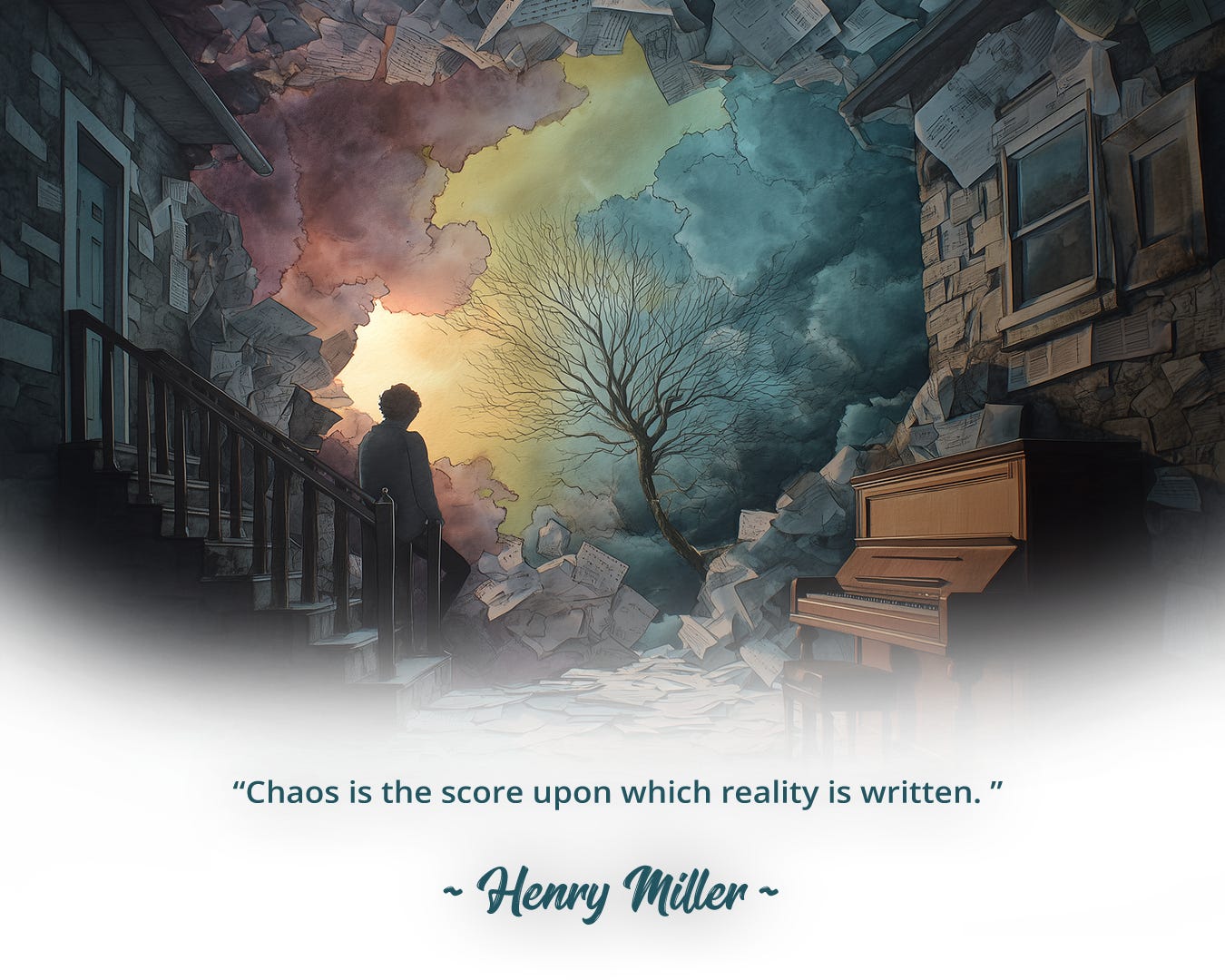
Chaos places us tottering on a cliff edge where we feel dizzy with vertigo. The desire to step back pulls hard. We can, however, choose to lie down on our stomachs and stare quietly into the abyss. As if in the center of the storm, we can wait for the lines to clear and the patterns to reveal themselves as order returns.
Until next time.
Yours in feeling,
Chantal & Matthew
*If you need a hint as to what is in the stereogram image, look for a butterfly.

Credits for this issue — Images: 5th Place
Written by

Chantal Dawtrey
Supporting women, especially in midlife and beyond, to navigate life transitions · Emotional fitness coach
Chantal supports women, especially in midlife and beyond, to navigate life transitions. She designs and delivers data informed digital programmes that build organisational emotional fitness. She helps people move beyond habitual patterns into greater awareness, agency, and well being.
With over 15 years of coaching experience and more than two decades in facilitation and human development, Chantal partners with individuals, teams, and organizations to build emotional resilience, enhance self-awareness, and develop sustainable well-being strategies.
Her primary focus as a coach is supporting women, especially those in their 50’s and beyond, to navigate profound life transitions with clarity, steadiness and self-reconnection. Finding answers to questions about identity, purpose, belonging and desire to an emergence, a reclamation and a return to self.
If you're going through a transition and would like support, let's talk.

Matthew Green
Reducing the Certainty Deficit in high-performing people and teams · Emotional fitness coach
Matthew works with athletes, performance teams, and anyone who wants to reduce the Certainty Deficit in their situation or context.
The Certainty Deficit is the space between what you can do and what your body will let you do when it counts. It is context-specific and situational. A person or athlete can have zero deficit in one situation and a significant one in another.
The body holds beliefs that keep the Certainty Deficit in place. These beliefs run deeper than self-talk and faster than any conscious strategy. When they shift, the ceiling shifts, and new possibilities arise.
Matthew is also an emotional fitness coach who supports individuals to live and lead from a place of inner clarity and stability. The work is somatic-first, practical, and grounded.
If you're seeing a pattern that current approaches haven't shifted, let's talk.
My origin story: Why elite athletes underperform when it counts
More from Enabling the How

It’s the oats
After weeks of challenge on many fronts it felt as if a threshold had been crossed. A smoother week with resolutions and relief.

The soundtrack to our lives
Leah knows what music she likes, so do we. Music is important to us and has a useful lesson to teach too.

All is not fair
The Boks are back and it’s great to be on the winning side but a wrong call by the ref can change that and the way we feel. All is not fair so managing our state is the real job to be done.