
Testing time
Nobody really likes to be assessed, so the resistance from staff members was not surprising. Clearing a misunderstanding through storytelling led most to do the assessment free of fear.

Who enjoys being assessed? The idea of being reviewed, tested or evaluated can elicit a stress response in even the most daredevil of us. We all have some unpleasant past experience that sits festering inside ready to rise, unwelcome, to tap at our sternums when we hear the word “test”.
Chantal’s worst experience was getting her driver’s license. She can still feel the tension in her shoulders and neck as she imagines herself walking towards the car with the assessor. Her hands shook as she started the car. She drove around Florida Dam seeing none of it, up and over the railway line and then almost stalling doing a three-point turn.
The worst was not the reverse parking that she had battled her long suffering father to get right, but reversing through hanging poles without touching them. This she had not practised, not aware that it was part of the test. Perspiration trickled down the side of her tense body as she manoeuvred through the swaying trap.
Miraculously she passed that test. The stress and tension still hovers over the memory, though.
Matthew’s experience was not so pointed and specific.
“I just did not like the idea of being tested in general,” he said, “I was intelligent but had no idea how to study, so I did well until it got to a point where I needed to study and I had no idea how to go about it.”
A resistance to assessment
It was no wonder, then, that the staff at a manufacturing company resisted the idea that they were going to be assessed. Not them specifically but their wellbeing. The initiative was driven by the tragic loss of a staff member to suicide. Nobody had any inkling that this person was suffering. Nobody foresaw his sudden demise. Everybody was shocked.
“We don’t want that to happen ever again,” said the HR manager.
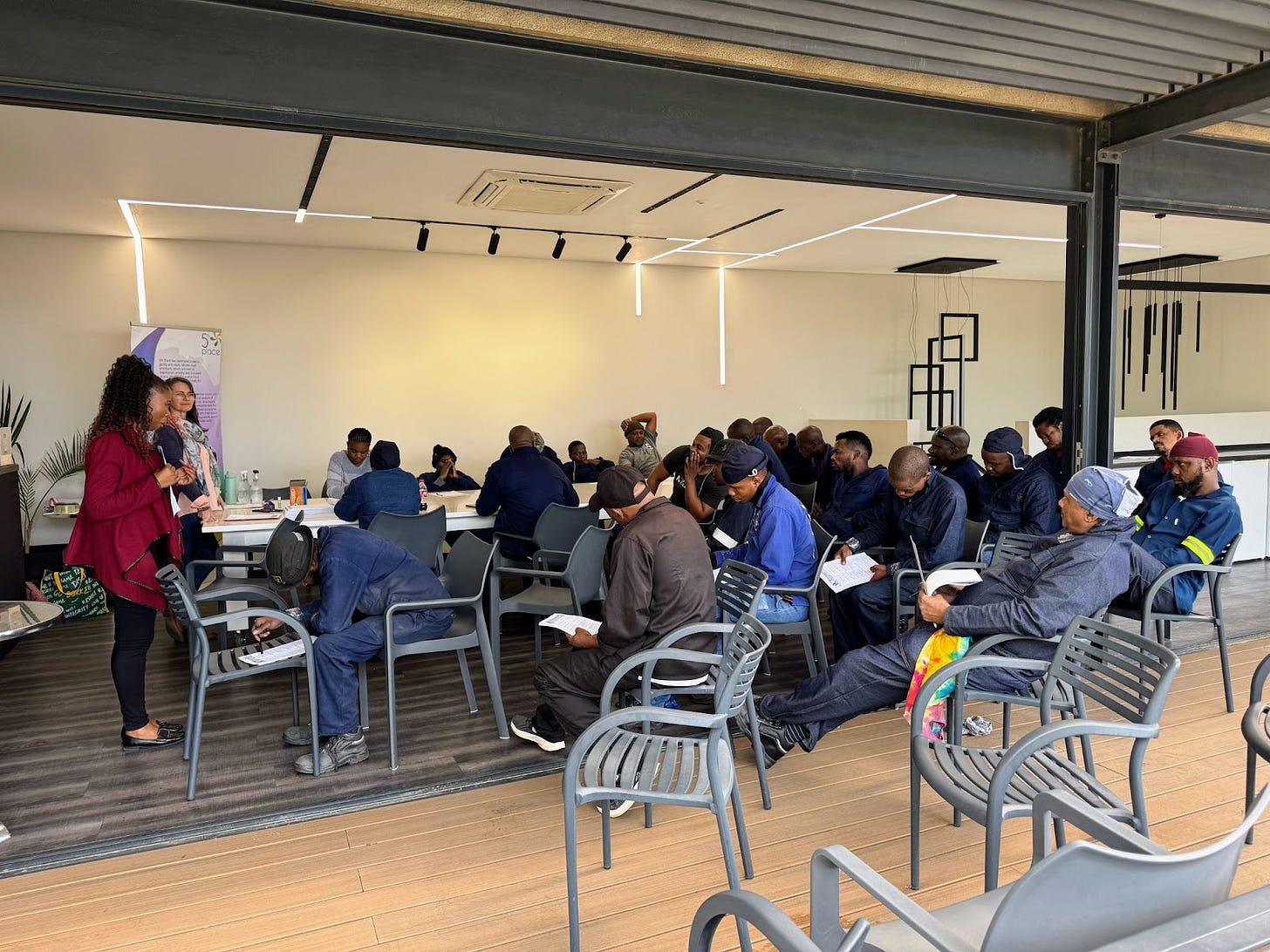
When the initiative was proposed, many of the staff, who do not have English as a first language, were not impressed. In conversation with the shop stewards it was clear that there had been a misunderstanding. Chantal was quickly able to dispel their concerns. It was agreed that presentations would take place that would clarify what the assessments were aimed at and how they would be conducted.
Our job was to conduct the assessments so that the company had an overall view of the stress levels of their staff. Any individual staff member at risk would be directly communicated with by us with recommendations of what they could do. No information about individuals would be shared with the company. This was crucial. In addition the assessments were voluntary. This was also important.
Imagine your favourite team
The best way to communicate something that is foreign, misunderstood or new is to tell a story. This is what Matthew did:
Imagine your favourite soccer team. If soccer’s not your thing, pick any team sport you love to watch. It’s the last game of the season, the one where everything’s on the line. A win today means victory, glory, the championship title. It’s Saturday afternoon, and you’re ready, ready to watch, ready to win. The odds are in your favour; your team’s been the most consistent all season. There’s a crackle of anticipation in the air as the game kicks off. Maybe you’re at home, with friends, or even in the stadium. You’re glued to the action, caught up in the ebb and flow as the game unfolds. Everything’s going to plan.
Or is it?
Midway through the first half, you notice one player’s a bit off. You brush it aside, it could be the pressure of the occasion, you tell yourself. But as the minutes tick by, it’s clear something’s wrong. Their passes are sloppy, their energy doesn’t match the team’s. They miss a tackle, then another. You feel the pressure building.
It’s halftime, and you’re relieved the score’s still 0-0. But that player? They’re worse now. You hope for a substitution, a fresh pair of legs. No such luck, the same team runs out for the second half. “How can they not see it?” you shout, more in desperation than hope.
The pressure keeps mounting. It’s wearing on the others now, they’re running harder, tackling more, covering for the sloppy play. It builds and builds until something has to break. And it does!
Just as you feared. The other team spots their chance, a player breaks loose down the side-line, swings the ball across the goal, and in an instant, it’s 1-0. The stadium erupts, but not for you. Jubilation surrounds you, but it’s not yours. As the clock ticks down, your dreams of a celebration break apart.

This is a story
But this is a story, and we can rewrite it however we choose. Let’s rewind to halftime and see if we can change the ending.
The team’s in the locker room, feeling the strain of the first half. The wise captain walks over to the struggling player and asks gently, “What’s going on?” The player hesitates, burdened by worry, unsure about speaking up, then finally opens up.
“Right before we ran out, I got a WhatsApp message. My uncle’s been in an accident, they’re in the hospital. They don’t know if he’ll make it. This uncle’s like a father to me.”
The player’s body is on the pitch, but their mind’s elsewhere, tangled in fear and uncertainty. No wonder they’re off. The captain listens, nodding quietly.
“Thanks for telling me. When we know, we can do something about it.”
The captain’s calm presence offers a lifeline, and soon they’re talking it through. The player agrees to let a few senior teammates step in, not only to tweak the game, but also to share the load of what’s weighing them down.
The second half begins, and you notice a change. The team’s energy feels different, it’s steadier and more connected. The struggling player isn’t quite back to normal, but they’re not as lost either. The others rally around, offering strength that goes beyond the field. By game’s end, it’s your captain standing tall, arms held high, dancing and jigging with the trophy aloft. Excitement and happiness buzz all around. This was the expected outcome, and now it’s the outcome!
“Because we knew,” the captain says in the post-match interview, grinning wide.

I have chosen me
The nodding heads indicated that the story had made an impression with the staff. It provided the segway into explaining why the assessments were being conducted. Twelve presentations were held, twelve times the story was told. Nearly 85% of the staff completed the assessments.
It’s not to say that everybody was completely honest, a brief run through shows that some simply ticked the boxes. It doesn’t matter, though. Those that need support and want help put themselves in line to get it.
Data capturing is still underway. We will soon have an understanding of the company’s emotional wellbeing quotient, thanks to those that were able to overcome their fear of being assessed.
It’s easy to stick our heads in the sand and avoid being reviewed. Not knowing is one strategy to hide from any potentially unpleasant truth. If I don’t know, I don’t need to deal with it.
If we are able to push through the discomfort we may find that the result is nothing to worry about. If there is a concern, at least we have given ourselves the chance to do something about it that is supportive and proactive. In this instance I have chosen me, and I have chosen life.
Until next time.
Yours in feeling,
Chantal & Matthew
Credits for this issue — Images: Midjourney & 5th Place
Written by

Chantal Dawtrey
Supporting women, especially in midlife and beyond, to navigate life transitions · Emotional fitness coach
Chantal supports women, especially in midlife and beyond, to navigate life transitions. She designs and delivers data informed digital programmes that build organisational emotional fitness. She helps people move beyond habitual patterns into greater awareness, agency, and well being.
With over 15 years of coaching experience and more than two decades in facilitation and human development, Chantal partners with individuals, teams, and organizations to build emotional resilience, enhance self-awareness, and develop sustainable well-being strategies.
Her primary focus as a coach is supporting women, especially those in their 50’s and beyond, to navigate profound life transitions with clarity, steadiness and self-reconnection. Finding answers to questions about identity, purpose, belonging and desire to an emergence, a reclamation and a return to self.
If you're going through a transition and would like support, let's talk.

Matthew Green
Reducing the Certainty Deficit in high-performing people and teams · Emotional fitness coach
Matthew works with athletes, performance teams, and anyone who wants to reduce the Certainty Deficit in their situation or context.
The Certainty Deficit is the space between what you can do and what your body will let you do when it counts. It is context-specific and situational. A person or athlete can have zero deficit in one situation and a significant one in another.
The body holds beliefs that keep the Certainty Deficit in place. These beliefs run deeper than self-talk and faster than any conscious strategy. When they shift, the ceiling shifts, and new possibilities arise.
Matthew is also an emotional fitness coach who supports individuals to live and lead from a place of inner clarity and stability. The work is somatic-first, practical, and grounded.
If you're seeing a pattern that current approaches haven't shifted, let's talk.
My origin story: Why elite athletes underperform when it counts
More from Enabling the How

It’s the oats
After weeks of challenge on many fronts it felt as if a threshold had been crossed. A smoother week with resolutions and relief.

The soundtrack to our lives
Leah knows what music she likes, so do we. Music is important to us and has a useful lesson to teach too.

All is not fair
The Boks are back and it’s great to be on the winning side but a wrong call by the ref can change that and the way we feel. All is not fair so managing our state is the real job to be done.