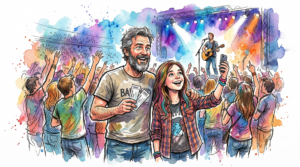
Sunday was Father’s Day and Youth Day in South Africa. Youth Day is a public holiday that commemorates the 1976 student uprisings in Soweto, when about 20,000 children took to the streets in protest of Afrikaans as the language of learning in schools. They were met with brutal police retaliation. Over 176 young people were shot and killed.
Father’s Day is not a public holiday, but is celebrated on the third Sunday of June. It is a day to honour our fathers, fatherhood, paternal bonds, and the influence of fathers in society. As we know fathers are important. Children look to their fathers to formulate rules, discipline and provide a sense of security. Fathers and father figures are valuable male role models for their children who look up to them, model their ways, beliefs and views.
In this country, however, there are far too many men who have produced children but not embraced the father figure role. A history of migrant labour and heavy financial cultural requirements for getting married plus high levels of teenage pregnancies have resulted in communities too full of single parent families and largely absent fathers.

Cannot hold both roles
It's the women that keep the family together, that work to keep bread on the table and books in the bags, it's the women that discipline, drive and run the households. For all their strength and hard work, the women cannot hold the role of both. And nor should they.
The weight the women carry in the community starts to weigh too heavily. As their children become adolescents, without the positive authority and discipline of the male role model, these young people can easily go astray. Lack of strong male guidance shows up in a sad cycle of history repeating itself.
In our work at Ikusasa Lethu we often are exposed to the impact of absent fathers. Deep distress at the loss of the father or father figure. Recurring concerns about not being good enough. Rage at being abandoned, or grief at the empty space in their lives.

Beautiful Winter sunsets are a thing. No, really. We mean it, just look at it!
Follow in the footsteps of fathers
Father’s are often key when it comes to the career choices of their offspring. Not only to provide for their education. Sons and daughters are known to follow in the footsteps of their fathers to become doctors, accountants, lawyers, actors and more.
Fathers who have pushed their offspring to become what they could never be fill the pages of memoirs and autobiographies. Watching tennis tournaments such as Roland Garros and Wimbledon remind us of how fundamental fathers have been for many of the star players over the years.
In the absence of father figures, who do our young people look to for inspiration and aspiration? Who are their real life mentors? When we ask that question of the young people at Ikusasa Lethu, the answers are firstly mothers, older sisters, and aunts. Occasionally a father, an older brother, an uncle, a teacher. Of course sports stars rate up there as do music stars.

Slightly less up close and personal with our aloe hedge. The one the birds and the bees love for Winter sustenance.
Searching for the balance
Matthew believes that in society today, men have lost their way. They have lost the essence of what it means to be masculine, and why it matters. They have become either overly aggressive and violent or floppy and with no direction or drive.
A generalisation, maybe, but he feels that the capitalist societies’ insatiable drive for power in the form of control and money has informed this.
“Where is the feminine in our cities, our technology, our structures?” he asked, shaking his head. “There has to be a balance and the feminine is not honoured, it is not given the proper acknowledgement and due.”
It is always about the balance and currently there is an imbalance. We need both the masculine and the feminine. Tempering, supporting, acknowledging and working together for the good of society and our children.

Father and son. Matthew was treated to a lovely outing by Tristan this year to a place that they both hold dear, Pirates Rugby Club.
We can do something
In our work we can’t do much about the absent fathers but we can do something about how these young people feel. We can teach them the skills to manage their feelings of lack and loss, rage and rumination. We can offer them alternative role models to the gangsters, rap artists and tiktok stars.
We can instil the importance of discipline, tenacity and grit. We can give hope where there is often little. We can affirm and support, appreciate and cheer those that arrive each Saturday in an effort to do better and be better.

Our new more permanent overflow compost bin is now up and running. The old one was made of wood and was self composting.
An example of balance
Over the weekend, Matthew picked up Andre Agassi’s autobiography, Open. Andre had been ruthlessly driven from a very young age by his overbearing father to play tennis. Although an exceptional player, Andre hated the sport. In spite of this he excelled and became one of the greatest tennis players of his era.
As Matthew flipped through a few pages of the book his eye fell on this excerpt where Andre describes the speech he gave for Steffi Graf, his wife, who was inducted into the international tennis hall of fame:
I look out over the crowd, the fans, the faces of former champions, and I want to tell them about Stefanie. I want them to know what I know. I compare her to the artisans and craftsmen who built the great mediaeval cathedrals: they didn’t curtail their perfectionism when building the roof or the cellar or other unseen parts of the cathedrals. They were perfectionists about every crevice and invisible corner—and that’s Stefanie. And yet also she’s a cathedral, a monument to perfection. I spend five minutes extolling her work ethic, her dignity, her legacy, her strength, her grace. In closing, I utter the truest thing I’ve ever said about her.
Ladies and gentleman, I introduce you to the greatest person I have ever known.
There was an example of balance, strength, femininity and grace. Of honouring and deep appreciation. Both had their fathers to thank for getting them into this sport. Both had excelled but had found real joy and love in each other.

A blast from the past! This time last year we were at the local celebration of the 60th wedding anniversary of Chantal’s parents.
Fathers offer love
Good fathers may bring discipline, structure and safety but they also offer love. A deep and caring love of their children and of the mothers of their children. It is this element that often gets lost. Being loved by a father builds self confidence, direction and certainty in a child.
In a letter to his brother, Vincent van Gogh, a brilliant but troubled man, wrote:
One cannot always tell what it is that keeps us shut in, confines us, seems to bury us, but still one feels certain barriers, certain gates, certain walls. Is all this imagination, fantasy? I do not think so. And then one asks: My God! Is it for long, is it for ever, is it for eternity? Do you know what frees one from this captivity? It is very deep serious affection. Being friends, being brothers, love, that is what opens the prison by supreme power, by some magic force.
— July 1880
Love is the supreme power, the magic force. If there is anything we can offer our children and young people today it is to love them. Love them with a force that reminds them that they matter. Love by brothers, fathers, grandfathers, step fathers and step in fathers.
To all the fathers and father figures that had loved like this, we thank you.
Until next time.
Yours in feeling,
Matthew & Chantal

Experience the ultimate journey in Emotional Mastery online! Our groundbreaking course, rated 4.94, will revolutionise your understanding and management of emotions.

You may also enjoy reading these
-
The window Arsenal struggles to close
Arsenal lost 4 matches in 3 weeks, each decided in the same 20-minute window. The Certainty Deficit explains why.
-
Why the Quad God Choked at the Olympics and Won Worlds Five Weeks Later
Ilia Malinin, the “Quad God”, scored 329 at Worlds and 156 at the Olympics. Five weeks apart. Same body. Same jumps. The Certainty Deficit explains why the Quad God delivered in one and collapsed in the other.
-
The Kick His Body Won’t Let Him Take
Manie Libbok kicked 73% for the Stormers. 58% in a Springbok jersey. Coach Rassie Erasmus spent two years engineering around the problem. The Certainty Deficit remained after all of it.
More articles from 5th Place
-
The emperor’s new emotions
Anthropic, the makers of Claude AI, missed a trick or two in trying to give Claude healthier psychology.
-
When He Said It Out Loud
Colson Baker stopped a show at the O2 Arena and said it out loud. Standing there with my daughter Darcy, something I’d been carrying for a long time got answered.
-
Why you feel worse after therapy & why it’s not your fault
Feeling worse after trying therapy or medication isn’t a sign you’re broken. It’s often a signal that the traditional approach is missing a crucial piece. Discover why your frustration is valid and how a different way, rooted in your body’s own intelligence, offers a path forward.